

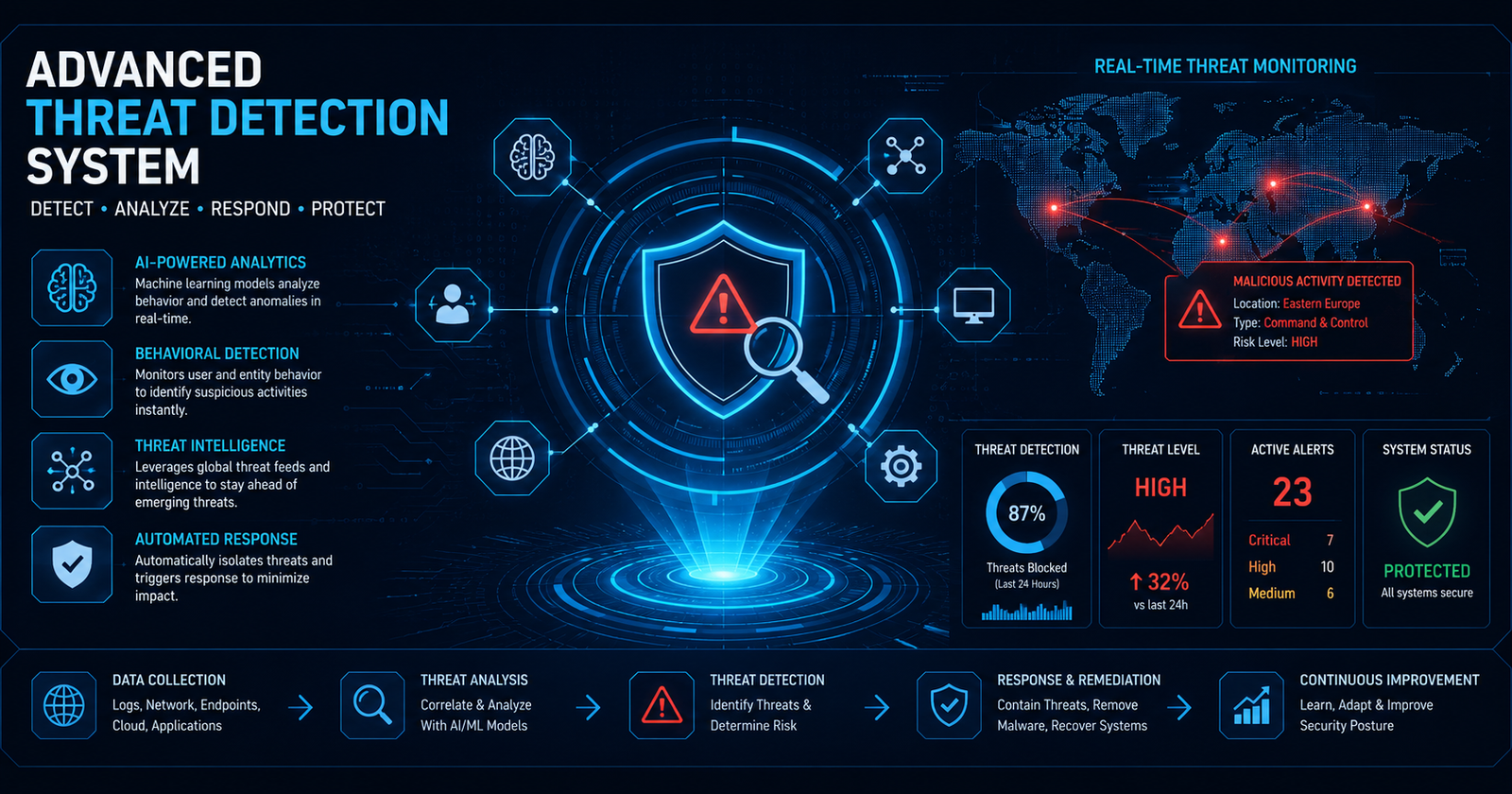
Cyber threats have become more sophisticated than ever. Modern attackers use fileless malware, zero-day exploits, ransomware, and advanced persistent threats (APTs) that can bypass traditional security tools. Firewalls and antivirus software still play an important role, but they often struggle to detect unknown or evolving attacks. This is where an Advanced Threat Detection System becomes essential.
An advanced threat detection system uses artificial intelligence (AI), machine learning (ML), behavioural analytics, and real-time threat intelligence to identify suspicious activity before it causes serious damage. Instead of relying solely on known malware signatures, these systems analyse user behaviour, network traffic, endpoints, cloud workloads, and security events to uncover hidden threats.
Whether you're protecting a small business or a large enterprise, implementing an advanced threat detection solution can significantly reduce security risks, improve incident response, and strengthen your overall cybersecurity strategy. This guide explains how advanced threat detection works, its key components, benefits, deployment best practices, and how it compares to traditional security solutions.
What Is an Advanced Threat Detection System?
An advanced threat detection system is a cybersecurity solution designed to identify, analyse, and respond to sophisticated cyberattacks in real time. Unlike traditional security tools that depend on predefined signatures, advanced detection platforms use intelligent analytics to discover both known and unknown threats.
These systems continuously collect data from multiple sources, including endpoints, servers, cloud environments, network devices, user accounts, and applications. They correlate this information using AI and behavioural analytics to identify abnormal activities that could indicate an attack.
For example, if an employee suddenly downloads hundreds of confidential files outside business hours while logging in from an unusual location, the system can immediately flag the activity as suspicious and trigger an automated response.
The primary goal is to minimise attacker dwell time, reduce false positives, and enable security teams to respond before a threat escalates into a major incident.
Why Traditional Threat Detection Is No Longer Enough
Traditional cybersecurity solutions remain valuable, but they were designed for an era when threats were far less complex.
Most legacy security products rely on signature-based detection, which works well for known malware but struggles against new attack techniques. Modern cybercriminals constantly modify their tactics, allowing them to bypass static detection methods.
Some major limitations of traditional detection include:
Inability to detect zero-day exploits
Limited visibility across cloud and hybrid environments
Poor detection of insider threats
High number of false positives
Slow manual investigation processes
Limited behavioural analysis
Today's attackers frequently use encrypted communication, stolen credentials, and legitimate system tools to avoid detection. These techniques make advanced threat detection essential for organisations seeking stronger protection.
How an Advanced Threat Detection System Works
An advanced threat detection system combines multiple technologies to identify suspicious behaviour quickly and accurately.
Data Collection
The process begins by gathering telemetry from numerous sources throughout the organisation.
These sources may include:
Endpoints
Firewalls
Email gateways
Identity providers
Cloud platforms
Applications
Network traffic
DNS logs
Security appliances
Collecting data from multiple environments creates a comprehensive view of organisational activity.
Threat Intelligence
Threat intelligence enhances detection by providing up-to-date information about malicious infrastructure, attack techniques, and known indicators of compromise (IOCs).
This intelligence is continuously updated from trusted security feeds and global research teams, helping organisations identify emerging threats before they spread.
Threat intelligence enables security teams to:
Block malicious IP addresses
Detect known malware families
Identify phishing campaigns
Monitor attacker infrastructure
Recognise ransomware activity
Behavioural Analytics
Behavioural analytics focuses on identifying deviations from normal activity instead of searching only for known malware.
The system establishes a baseline of typical user and device behaviour. When unusual actions occur, such as excessive file transfers or suspicious login attempts, alerts are generated.
Examples include:
Impossible travel logins
Unusual administrator activity
Unexpected privilege escalation
Large data transfers
Access outside normal working hours
Behavioural analytics is particularly effective for detecting insider threats and compromised accounts.
Machine Learning
Machine learning continuously improves detection accuracy by analysing massive amounts of security data.
Instead of relying on manually created rules, ML models recognise subtle attack patterns that human analysts may overlook.
Machine learning can identify:
Unknown malware
Zero-day attacks
Anomalous network traffic
Credential misuse
Lateral movement
Data exfiltration
As new attacks emerge, detection models evolve without requiring constant manual updates.
Automated Response
Once a threat reaches a defined risk threshold, automated response capabilities help contain it immediately.
Common automated actions include:
Isolating infected devices
Blocking malicious domains
Disabling compromised accounts
Terminating suspicious processes
Creating incident tickets
Launching SOAR workflows
Automation dramatically reduces response times while allowing SOC analysts to focus on high-priority investigations.
Core Components of an Advanced Threat Detection System
Several technologies work together to deliver effective threat detection.
Artificial Intelligence Engine
AI analyses enormous volumes of security events to detect suspicious patterns in real time.
Unlike static rules, AI adapts as attackers develop new techniques, improving detection accuracy over time.
Behaviour Analytics
User and Entity Behaviour Analytics (UEBA) monitors users, devices, and applications to detect unusual activity that may indicate compromised credentials or insider threats.
Threat Intelligence Platform
Threat intelligence enriches security events with external context, allowing analysts to identify malicious infrastructure more quickly.
It also reduces investigation time by automatically correlating events with known attack campaigns.
Endpoint Detection
Endpoints remain one of the most common attack targets.
Advanced endpoint monitoring detects:
Malware
Fileless attacks
Suspicious PowerShell execution
Registry modifications
Process injection
Privilege escalation
Network Detection
Network monitoring analyses east-west and north-south traffic to identify suspicious communication.
This visibility helps uncover:
Lateral movement
Command-and-control traffic
DNS tunnelling
Data exfiltration
Network reconnaissance
Cloud Security Monitoring
Modern organisations rely heavily on cloud infrastructure.
An advanced threat detection system monitors cloud workloads, virtual machines, SaaS applications, and cloud identities to identify risky behaviour across hybrid environments.
Types of Threats an Advanced Threat Detection System Can Detect
One of the biggest advantages of intelligent threat detection is its ability to identify a wide variety of attack techniques before they become full-scale security incidents.
By combining AI, behavioural analytics, and threat intelligence, organisations gain far greater visibility into sophisticated attacks than traditional security tools can provide.
Advanced Threat Detection System vs Traditional Security Tools
Many organisations assume antivirus software or firewalls alone provide adequate protection. While these solutions remain important, they serve different purposes than an advanced threat detection system.
Traditional security solutions focus on preventing known threats, while an advanced threat detection system continuously monitors, analyses, and responds to sophisticated attacks across the entire IT environment.
Key Benefits of Implementing an Advanced Threat Detection System
Deploying an advanced threat detection system offers far more than improved malware detection. It strengthens the organisation's overall security posture by providing proactive visibility into evolving threats.
Key benefits include:
Faster threat detection and containment
Improved visibility across endpoints, networks, and cloud environments
Reduced false positives through AI-driven analysis
Enhanced protection against ransomware, zero-day exploits, and insider threats
Better support for Security Operations Centre (SOC) teams
Automated incident response that reduces manual workloads
Improved compliance reporting and audit readiness
Greater resilience against modern cyberattacks
As organisations continue adopting cloud services and remote work, intelligent threat detection becomes an essential layer of defence rather than an optional security enhancement.
Real-World Use Cases of an Advanced Threat Detection System
Organisations across different industries rely on advanced threat detection systems to defend against increasingly sophisticated cyber threats. These solutions provide continuous monitoring and rapid incident response, reducing both financial losses and operational disruption.
Financial Services
Banks and financial institutions process millions of transactions every day, making them prime targets for cybercriminals. An advanced threat detection system can identify fraudulent login attempts, account takeovers, and unusual transaction patterns before they result in data breaches or financial fraud.
For example, if an attacker attempts to access multiple customer accounts from different locations within minutes, behavioural analytics can flag the activity and trigger an automatic investigation.
Healthcare
Healthcare organisations store highly sensitive patient information and medical records. Threat detection systems monitor hospital networks, connected medical devices, and cloud applications to identify ransomware, phishing attempts, and insider threats.
Continuous monitoring helps prevent unauthorised access to patient data while supporting regulatory compliance.
Manufacturing
Manufacturers increasingly depend on connected operational technology (OT) and industrial control systems. Advanced detection solutions identify suspicious activity targeting production environments, helping organisations prevent downtime caused by ransomware or supply chain attacks.
Retail and E-commerce
Retail businesses process large volumes of customer payment information. Threat detection platforms monitor point-of-sale systems, online payment gateways, and employee accounts to detect fraudulent behaviour before customer information is compromised.
Government and Public Sector
Government agencies face constant threats from cybercriminals and nation-state attackers. Advanced threat detection systems provide greater visibility into network activity, enabling security teams to identify espionage campaigns, credential theft, and advanced persistent threats quickly.
Advanced Threat Detection in Cloud and Hybrid Environments
Today's organisations rarely operate entirely on-premises. Most businesses use a combination of cloud services, SaaS applications, remote work environments, and traditional data centres.
An advanced threat detection system provides visibility across these complex environments by monitoring:
Microsoft Azure
Amazon Web Services (AWS)
Google Cloud Platform (GCP)
Microsoft 365
Hybrid cloud infrastructure
Virtual machines
Containers
Kubernetes clusters
Cloud identities
By analysing cloud activity alongside on-premises infrastructure, organisations gain a unified security view that helps detect attacks moving across multiple environments.
Integrating an Advanced Threat Detection System with Existing Security Tools
Modern cybersecurity works best when multiple security technologies operate together.
An advanced threat detection platform can integrate with:
Security Information and Event Management (SIEM)
Security Orchestration, Automation and Response (SOAR)
Endpoint Detection and Response (EDR)
Extended Detection and Response (XDR)
Firewalls
Identity and Access Management (IAM)
Email security gateways
Threat intelligence platforms
Many organisations use Splunk Detection Studio to build and manage custom detection rules while combining alerts from multiple data sources. Security analysts also use Splunk threat hunting techniques to proactively search for hidden threats that may not trigger automated alerts.
Businesses using Palo Alto Networks security solutions can further strengthen protection through Palo Alto Advanced Threat Prevention, which analyses encrypted traffic, identifies unknown threats, and blocks malicious activity before it reaches critical assets.
Best Practices for Deploying an Advanced Threat Detection System
Successful deployment requires more than installing software. Organisations should follow a structured implementation strategy.
Start by identifying all assets connected to the network, including endpoints, cloud workloads, applications, and IoT devices. Without complete visibility, attackers may exploit unmanaged systems.
Regularly update threat intelligence feeds to ensure the system recognises newly discovered attack techniques.
Integrate the platform with existing security tools to improve correlation and reduce investigation time.
Establish incident response procedures before deployment so security teams understand how to respond when alerts occur.
Provide ongoing training for SOC analysts to improve alert validation and reduce false positives.
Review detection policies regularly as business operations and threat landscapes evolve.
Common Challenges and How to Overcome Them
Although advanced threat detection systems provide significant benefits, organisations should prepare for several implementation challenges.
Alert Fatigue
Large organisations may receive thousands of alerts every day.
Using AI-driven risk scoring and behavioural analytics helps prioritise the most critical incidents while reducing unnecessary notifications.
Integration Complexity
Older infrastructure may not integrate easily with modern detection platforms.
Selecting solutions that support open APIs and industry-standard integrations simplifies deployment.
Skills Shortage
Cybersecurity professionals remain in high demand.
Automation and managed detection services can help organisations with limited in-house expertise.
Budget Constraints
Advanced security platforms represent an investment.
Businesses should prioritise solutions that provide scalable licensing and measurable return on investment through reduced incident costs.
How to Choose the Right Advanced Threat Detection System
Selecting the right solution depends on your organisation's infrastructure, security maturity, and operational requirements.
Consider the following evaluation criteria.
If your organisation uses Palo Alto firewalls, review the Palo Alto Advanced Threat Prevention datasheet to understand supported capabilities before deployment.
Businesses should also evaluate the appropriate Palo Alto Threat Prevention license based on their network size and security requirements. Proper Palo Alto threat prevention configuration is equally important to ensure policies, security profiles, and threat signatures operate effectively. Administrators should always verify how to Palo Alto enable advanced threat prevention features after installation to maximise protection.
Future Trends in Advanced Threat Detection
Cybersecurity continues to evolve rapidly, and threat detection technologies are becoming increasingly intelligent.
Several trends are shaping the future.
Artificial intelligence will automate more security investigations, reducing analyst workloads.
Generative AI will assist security teams in analysing incidents, summarising attack patterns, and recommending response actions.
Extended Detection and Response (XDR) platforms will continue integrating endpoint, cloud, identity, and network telemetry into a single detection engine.
Predictive analytics will identify attack indicators before exploitation occurs.
Threat intelligence sharing between organisations will improve collective defence against emerging cyber threats.
As attackers adopt AI-powered techniques, defenders must continue investing in advanced detection capabilities to remain resilient.
Conclusion
An advanced threat detection system has become a critical component of modern cybersecurity. As attackers adopt increasingly sophisticated techniques, organisations can no longer rely solely on traditional security tools. AI-driven detection, behavioural analytics, machine learning, and real-time threat intelligence provide the visibility needed to identify threats before they cause serious damage.
Whether securing cloud environments, hybrid infrastructure, or on-premises networks, advanced threat detection improves incident response, strengthens operational resilience, and helps organisations stay ahead of evolving cyber risks. Investing in a well-integrated solution supported by skilled analysts and continuous monitoring creates a stronger security posture capable of defending against today's most advanced attacks.
Frequently Asked Questions
What is an advanced threat detection system?
An advanced threat detection system is a cybersecurity solution that uses AI, behavioural analytics, machine learning, and threat intelligence to identify and respond to sophisticated cyber threats in real time.
How is advanced threat detection different from antivirus software?
Traditional antivirus relies primarily on known malware signatures, while advanced threat detection analyses behaviour, network activity, and anomalies to identify both known and unknown attacks.
Can small businesses benefit from advanced threat detection?
Yes. Small businesses increasingly face ransomware and phishing attacks. Cloud-based advanced threat detection solutions provide enterprise-grade protection without requiring large security teams.
What threats can an advanced threat detection system identify?
It can detect ransomware, insider threats, phishing attacks, zero-day exploits, credential theft, advanced persistent threats, lateral movement, data exfiltration, and suspicious user behaviour.
Does advanced threat detection replace SIEM or EDR?
No. It complements SIEM, EDR, XDR, firewalls, and other security tools by providing enhanced analytics, behavioural monitoring, and automated response capabilities.
How does artificial intelligence improve threat detection?
AI analyses massive amounts of security data, identifies hidden attack patterns, reduces false positives, prioritises high-risk alerts, and accelerates incident response.
Leave a Reply