

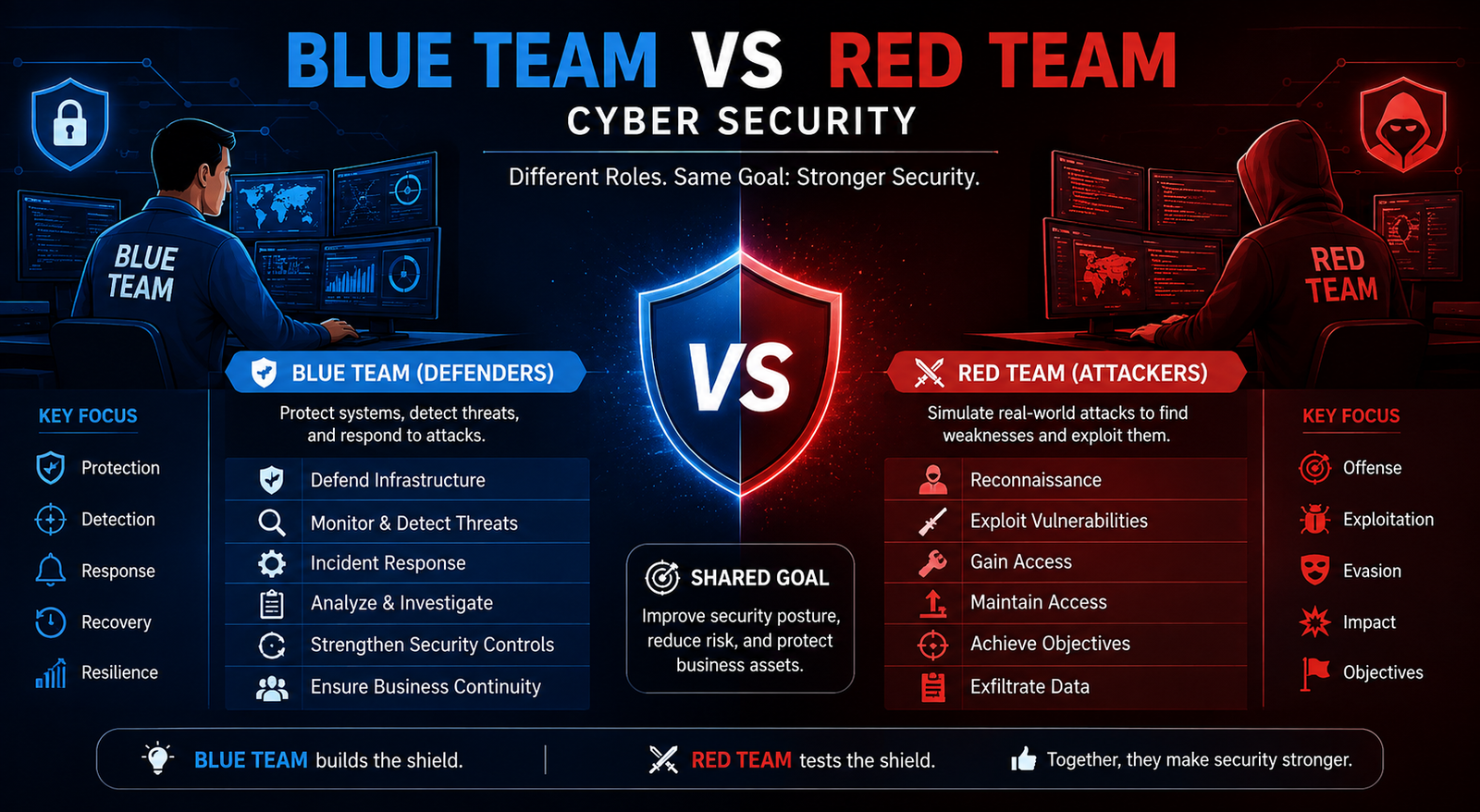
Cybersecurity is no longer just about installing antivirus software or setting up a firewall. Modern organizations face increasingly sophisticated cyber threats that require both proactive and reactive security strategies. This is where blue team vs red team cyber security becomes an essential concept. While the Red Team simulates attacks to uncover security weaknesses, the Blue Team focuses on detecting, preventing, and responding to those attacks. Rather than competing, these teams work together to improve an organization's overall security posture.
Whether you're exploring a career in cybersecurity, managing enterprise security, or simply trying to understand how modern cyber defense works, knowing the difference between Red and Blue Teams is invaluable. This guide explains their roles, responsibilities, tools, workflows, and how they collaborate to keep businesses protected from evolving cyber threats.
What Is a Red Team in Cyber Security?
A Red Team is a specialized group of cybersecurity professionals who think and act like real attackers. Their mission is to simulate realistic cyberattacks against an organization to identify vulnerabilities before criminals can exploit them. Instead of simply finding technical flaws, Red Team engagements evaluate the effectiveness of people, processes, and security technologies under real-world conditions.
Organizations often use Red Teams to test their resilience against advanced threats such as ransomware attacks, phishing campaigns, insider threats, and cloud-based attacks. The findings help security leaders understand where improvements are needed before a genuine breach occurs.
Core Responsibilities of a Red Team
Red Team professionals perform several offensive security activities, including:
Conducting reconnaissance on target systems
Performing penetration testing
Running phishing and social engineering campaigns
Assessing physical security controls
Testing cloud infrastructure
Identifying privilege escalation opportunities
Simulating ransomware attacks
Producing detailed reports with remediation recommendations
Their objective is not to cause damage but to expose weaknesses that defenders can fix before attackers discover them.
Typical Red Team Engagement Process
A Red Team engagement generally follows these stages:
Planning and defining objectives
Intelligence gathering
Reconnaissance and scanning
Initial access
Privilege escalation
Lateral movement
Data access or exfiltration simulation
Reporting and recommendations
For example, a financial institution may hire a Red Team to simulate a ransomware attack. The team begins with phishing emails, gains access to an employee workstation, moves laterally through the network, attempts to reach sensitive systems, and finally documents every weakness uncovered during the assessment.
What Is a Blue Team in Cyber Security?
A Blue Team is responsible for protecting an organization's infrastructure from cyber threats. Unlike the Red Team, which focuses on attacking systems ethically, the Blue Team works continuously to detect suspicious activity, investigate incidents, and strengthen defenses before attacks become successful.
Blue Teams operate as the organization's frontline defenders. They monitor networks around the clock, respond to alerts, improve detection capabilities, and help ensure business operations continue even during cyber incidents.
Core Responsibilities of a Blue Team
Typical Blue Team responsibilities include:
Monitoring security alerts
Investigating suspicious activity
Managing SIEM platforms
Conducting threat hunting
Responding to incidents
Performing malware analysis
Managing vulnerabilities
Developing detection rules
Improving security policies
Supporting compliance initiatives
Blue Team members constantly refine their defenses based on emerging threats and lessons learned from previous attacks.
A Typical Blue Team Workflow
A normal day for a Blue Team often involves:
Reviewing security alerts
Prioritizing high-risk events
Investigating suspicious behavior
Isolating compromised systems
Removing malicious software
Recovering affected services
Documenting findings
Updating monitoring rules
Imagine an employee unknowingly clicks a phishing email. The Blue Team quickly detects unusual PowerShell activity, isolates the infected endpoint, analyzes the malware, resets compromised credentials, and updates security controls to prevent similar attacks in the future.
Blue Team vs Red Team Cyber Security: Key Differences
Although both teams contribute to stronger cybersecurity, they have very different objectives and responsibilities.
The Red Team actively searches for weaknesses, while the Blue Team works to identify and stop attacks before they cause damage. Together, they provide organizations with a balanced and effective cybersecurity strategy.
How Red Teams and Blue Teams Work Together
Although their responsibilities differ, Red and Blue Teams are most effective when they collaborate. Every successful Red Team exercise provides valuable insights that help the Blue Team improve detection capabilities, strengthen security controls, and refine incident response procedures.
For example, if a Red Team successfully bypasses email security using a phishing campaign, the Blue Team can use that information to improve email filtering, enhance employee awareness training, and develop new detection rules.
This continuous cycle of testing, learning, and improving creates a stronger security posture over time.
Benefits of Collaboration
Organizations gain several advantages when Red and Blue Teams work together:
Better detection of advanced threats
Faster incident response
Improved security awareness
Stronger defensive controls
Reduced attack surface
Continuous improvement through realistic testing
Instead of viewing each other as competitors, successful organizations encourage both teams to share knowledge and collaborate toward the common goal of protecting critical assets.
What Is a Purple Team?
A Purple Team is not a separate security department but a collaborative approach that brings Red and Blue Teams together. During Purple Team exercises, offensive and defensive professionals share information in real time to improve both attack simulations and defensive capabilities.
Rather than waiting until the end of an assessment, both teams communicate throughout the engagement, allowing defenders to understand attacker techniques while attackers verify whether security improvements are effective.
Purple Teaming enables organizations to accelerate security improvements by combining offensive testing with defensive expertise.
Real-World Attack Simulation: Red Team vs Blue Team
Consider a manufacturing company that wants to evaluate its cybersecurity readiness.
The Red Team begins by sending carefully crafted phishing emails to employees. One employee opens a malicious attachment, allowing the Red Team to gain an initial foothold within the network. They attempt privilege escalation and move laterally toward critical business systems.
Meanwhile, the Blue Team notices unusual authentication attempts and suspicious PowerShell activity. Security analysts investigate the alerts, isolate the compromised device, block malicious connections, and begin threat hunting to identify additional indicators of compromise.
After the exercise concludes, both teams meet to review the findings. The organization improves email security, strengthens endpoint protection, updates monitoring rules, and provides additional employee security awareness training.
This collaborative process helps identify weaknesses before real attackers can exploit them.
Tools Used by Red Teams and Blue Teams
Both teams rely on specialized cybersecurity tools, although their purposes differ significantly.
Red Team tools help simulate attacks and identify vulnerabilities, while Blue Team platforms focus on monitoring, detection, investigation, and incident response.
Skills Required for Red Team vs Blue Team Careers
Both career paths require strong technical knowledge, but they emphasize different skill sets.
Red Team Skills
Networking fundamentals
Linux administration
Windows internals
Active Directory security
Web application security
Exploit development
Python and PowerShell scripting
Cloud security testing
Social engineering techniques
Blue Team Skills
Security Information and Event Management (SIEM)
Threat hunting
Incident response
Digital forensics
Malware analysis
Detection engineering
Log analysis
Network monitoring
Vulnerability management
Professionals who understand both offensive and defensive security often become more effective cybersecurity experts because they appreciate how attackers operate and how defenders can stop them.
Certifications for Each Career Path
Professional certifications help validate technical skills and improve career opportunities.
Red Team certifications focus on offensive techniques, while Blue Team certifications emphasize detection, incident response, and defensive security operations.
MITRE ATT&CK Framework and Team Responsibilities
One of the most valuable frameworks in modern cybersecurity is the MITRE ATT&CK Framework. It provides a comprehensive knowledge base of real-world attacker tactics and techniques, allowing organizations to understand how threats progress through different stages of an attack.
Red Teams use MITRE ATT&CK to emulate realistic adversary behavior during security assessments. By following documented attack techniques, they can simulate sophisticated campaigns that closely resemble those used by actual threat actors.
Blue Teams rely on the same framework to build detection rules, map security alerts, improve threat hunting activities, and identify defensive gaps. Aligning detections with MITRE ATT&CK helps security teams prioritize improvements and measure their defensive coverage.
By using a common framework, both teams communicate more effectively and continuously improve an organization's cyber resilience.
Red Team vs Penetration Testing
Many people use the terms Red Team and penetration testing interchangeably, but they are not the same. A penetration test focuses on identifying and validating vulnerabilities within a defined scope. A Red Team engagement is broader and aims to simulate a real attacker over an extended period while testing people, processes, and technology together.
Organizations often conduct penetration tests regularly and schedule Red Team exercises annually or before major business changes.
Blue Team Incident Response Lifecycle
When a cyberattack occurs, the Blue Team follows a structured incident response process to minimize damage and restore normal operations.
Preparation
Develop security policies, deploy monitoring tools, and train employees before incidents occur.
Identification
Analyze alerts, investigate suspicious activity, and determine whether an actual security incident exists.
Containment
Isolate compromised devices, block malicious connections, and prevent the attack from spreading.
Eradication
Remove malware, eliminate attacker persistence, and close exploited vulnerabilities.
Recovery
Restore affected systems, validate business services, and continue monitoring for unusual activity.
Lessons Learned
Document the incident, identify improvement opportunities, and strengthen detection capabilities for future attacks.
A disciplined incident response process helps organizations recover faster and reduce the impact of future cyber threats.
Red Team Engagement Lifecycle
A successful Red Team exercise follows a carefully planned methodology designed to emulate sophisticated attackers without disrupting business operations.
The lifecycle typically includes:
Defining objectives and rules of engagement
Collecting intelligence about the target
Performing reconnaissance
Gaining initial access
Escalating privileges
Moving laterally across the network
Accessing sensitive data
Preparing a comprehensive report with remediation recommendations
Every phase provides valuable insights that enable organizations to improve their overall security posture.
AI in Red Team and Blue Team Operations
Artificial intelligence is transforming offensive and defensive cybersecurity alike.
AI for Red Teams
Red Teams use AI to automate reconnaissance, analyze large datasets, identify potential attack paths, generate realistic phishing content, and improve vulnerability discovery. AI allows offensive teams to spend more time on strategic testing instead of repetitive tasks.
AI for Blue Teams
Blue Teams use AI-powered security platforms to detect abnormal behavior, prioritize alerts, automate investigations, and accelerate incident response. Security Operations Centers increasingly rely on AI to reduce alert fatigue and identify threats that traditional rule-based systems might miss.
Although AI improves efficiency, human expertise remains essential for interpreting results, making decisions, and responding to complex attacks.
Cloud Security: Red Team vs Blue Team
As businesses migrate to cloud platforms, security responsibilities evolve.
Red Teams assess cloud environments by testing identity management, storage configurations, access controls, APIs, and cloud-native applications. They search for misconfigurations that attackers commonly exploit.
Blue Teams monitor cloud logs, detect suspicious user behavior, secure cloud identities, enforce least-privilege access, and continuously monitor workloads for threats.
Whether using AWS, Microsoft Azure, or Google Cloud, organizations benefit from combining offensive assessments with continuous cloud monitoring.
Key Performance Indicators (KPIs) for Red and Blue Teams
Measuring cybersecurity effectiveness helps organizations continuously improve.
These metrics provide leadership with measurable evidence of security improvements and help prioritize future investments.
Which Career Should You Choose?
Both career paths offer excellent opportunities, but the right choice depends on your interests and strengths.
Choose a Red Team career if you enjoy ethical hacking, solving technical challenges, researching vulnerabilities, and thinking creatively like an attacker. Offensive security professionals often work as penetration testers, Red Team operators, or security consultants.
Choose a Blue Team career if you enjoy monitoring systems, analyzing threats, investigating incidents, and protecting organizations from cyberattacks. Popular roles include SOC Analyst, Incident Responder, Threat Hunter, and Detection Engineer.
Many experienced professionals eventually gain expertise in both offensive and defensive security, making them highly valuable to employers.
Best Practices for Organizations
Organizations can maximize their cybersecurity maturity by adopting proven security practices.
Conduct regular Red Team exercises.
Continuously monitor systems with a dedicated Blue Team.
Encourage Purple Team collaboration.
Align security operations with the MITRE ATT&CK Framework.
Implement a robust incident response plan.
Perform routine vulnerability assessments.
Strengthen employee security awareness training.
Measure security performance using meaningful KPIs.
Continuously update detection rules and monitoring capabilities.
Security is an ongoing process rather than a one-time project. Continuous testing and improvement are essential for staying ahead of evolving threats.
Conclusion
Understanding blue team vs red team cyber security is essential for anyone interested in modern cybersecurity. Red Teams proactively identify weaknesses by simulating realistic attacks, while Blue Teams protect organizations through continuous monitoring, threat detection, and incident response. Rather than competing, these teams complement one another, creating a continuous cycle of testing, learning, and improvement.
As cyber threats continue to evolve, organizations that combine Red Team assessments, Blue Team operations, and Purple Team collaboration are better equipped to detect attacks early, reduce risk, and strengthen their overall security posture. Whether you're building a cybersecurity career or improving your organization's defenses, mastering both perspectives provides a significant advantage.
Frequently Asked Questions
Is Red Team better than Blue Team?
Neither is better than the other. Red Teams identify weaknesses through simulated attacks, while Blue Teams defend against real threats. Organizations achieve the best security by using both together.
What is red team and blue team in cyber security?
A Red Team performs ethical hacking and adversary simulations to identify vulnerabilities, whereas a Blue Team focuses on monitoring, detecting, responding to, and preventing cyberattacks across an organization's environment.
What is a Purple Team in cybersecurity?
A Purple Team promotes collaboration between offensive and defensive security teams. It helps organizations improve detection capabilities and accelerate security improvements through shared knowledge.
What is the difference between Red Team and penetration testing?
Penetration testing identifies vulnerabilities within a defined scope, while Red Team engagements simulate real-world attackers across people, processes, and technology to evaluate overall security readiness.
Which cybersecurity career pays more?
Compensation varies by location, experience, certifications, and employer. Senior Red Team operators and experienced Blue Team specialists can both earn competitive salaries, with leadership and specialized cloud security roles often commanding higher pay.
Can one person perform both Red Team and Blue Team roles?
Yes. Many cybersecurity professionals develop expertise in both offensive and defensive security. These individuals are often referred to as Purple Team practitioners because they understand attacker techniques as well as defensive operations.
Leave a Reply