

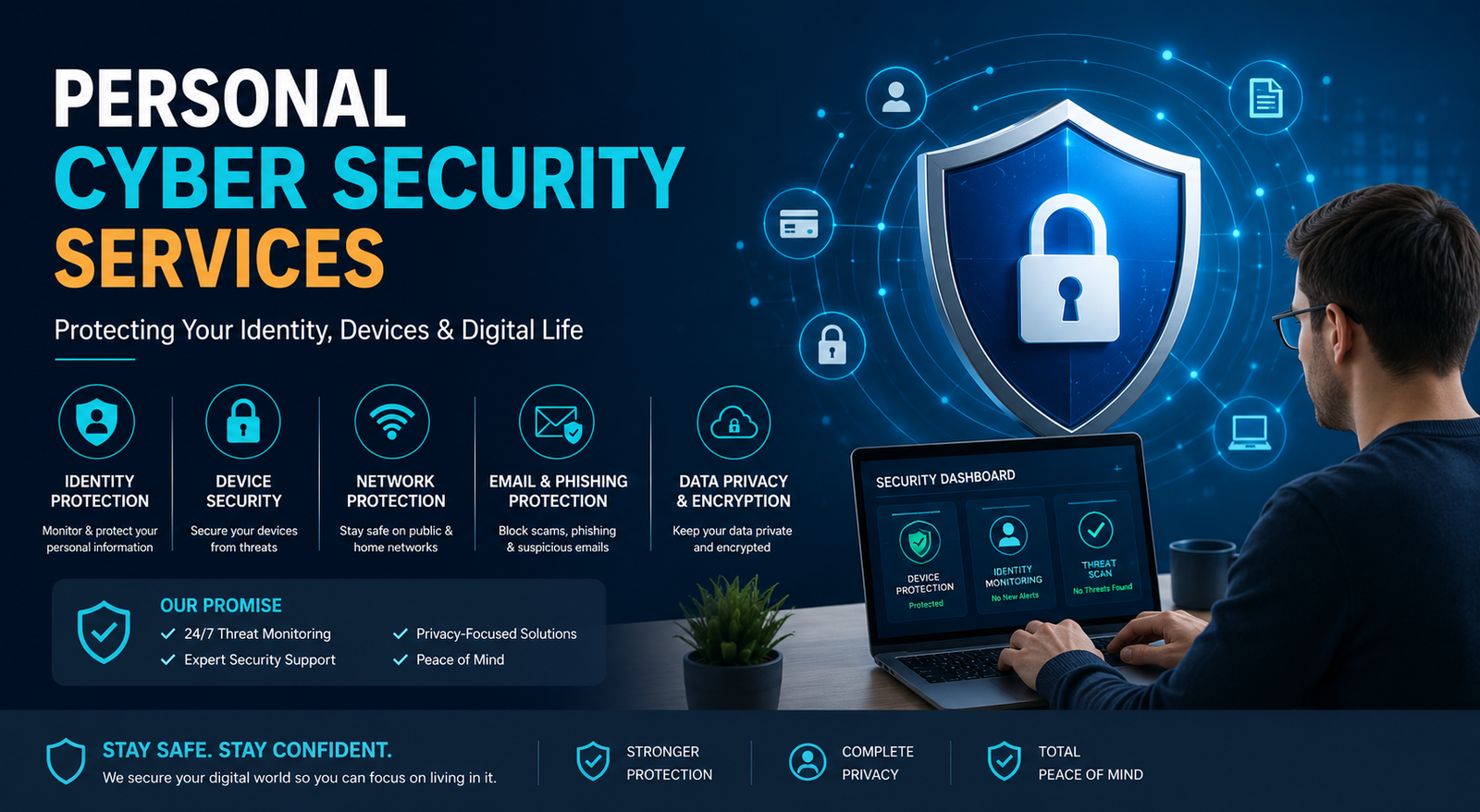
Your digital life includes much more than a laptop or smartphone. Email accounts, banking apps, social media, cloud storage, smart-home devices, personal documents, and online identities can all become targets for cybercriminals. A single compromised account can sometimes expose several other parts of your digital life.
Personal cyber security services provide professional help to identify these risks and strengthen your protection. Unlike a single security app, professional services can assess your accounts, devices, home network, privacy exposure, and recovery options as one connected security environment.
Whether you are a home user, remote worker, freelancer, business owner, executive, or someone recovering from a cyber incident, understanding what these services include can help you choose the right level of protection.
What Are Personal Cyber Security Services?
Personal cyber security services are professional solutions designed to protect an individual's devices, online accounts, personal information, identity, privacy, and home network from cyber threats.
Depending on the provider, services may include security assessments, account protection, device hardening, password and authentication reviews, home Wi-Fi security, digital privacy assessments, identity protection, monitoring, and incident response.
The key difference is personalization. Security software can automatically detect certain threats, but a professional can evaluate how your accounts, devices, habits, and online exposure interact. This makes personal cyber security services particularly useful for people with higher risks or complex digital environments.
Why Personal Cybersecurity Matters
Cybercriminals do not only target large organizations. Individuals can be targeted for financial information, passwords, identity data, cryptocurrency, personal documents, social media accounts, or access to business systems.
Common threats include phishing, malware, ransomware, identity theft, credential theft, account takeover, SIM swapping, social engineering, and online scams. Weak passwords or an unsecured recovery email can sometimes create a chain reaction in which one compromised account leads to several others.
For example, imagine someone gains access to your personal email. If that email is also the recovery address for your social media and cloud storage, the attacker may be able to reset those accounts. A personal cybersecurity assessment can identify these connections before an attacker does.
What Do Personal Cyber Security Services Include?
The exact personal cyber security services list varies between providers, but comprehensive protection usually covers several important areas.
Personal Cybersecurity Assessment
A cybersecurity assessment examines your current security posture and identifies weaknesses. It may review important accounts, authentication methods, devices, home networks, privacy settings, backups, and recovery options.
The goal is not simply to find problems. A good assessment should prioritize them so you know which weaknesses need attention first.
Account and Password Security
Professionals can help review password practices and improve account security through unique passwords, password managers, multi-factor authentication, passkeys, recovery codes, and secure recovery accounts.
Your primary email deserves particular attention because it is often connected to password resets for other services.
Device Security
Personal devices may contain financial information, photographs, documents, saved passwords, and authentication credentials. Services can help strengthen laptops, smartphones, tablets, and other connected devices.
This can include operating-system updates, encryption, secure screen locks, application permissions, anti-malware protection, backups, and appropriate device-recovery settings.
Home Network Security
Your router is an important part of your digital security. Personal cyber security services can review router credentials, firmware, Wi-Fi configuration, connected devices, guest networks, and smart-home equipment.
For example, a household with cameras, smart TVs, gaming consoles, and IoT devices may benefit from separating less-trusted devices from computers containing sensitive information.
Email and Phishing Protection
Phishing remains one of the most common ways attackers trick people into revealing credentials or installing malicious software.
A professional can help improve email security, recognize suspicious messages, protect recovery accounts, and strengthen authentication. The objective is to reduce dependence on recognizing every scam perfectly.
Identity and Privacy Protection
Privacy-focused services can examine what personal information is publicly available and how much information is exposed through social media, old accounts, people-search websites, and data brokers.
Digital footprint reduction can be particularly valuable for executives, business owners, public-facing professionals, and people who have experienced harassment or targeted attacks.
Phone and SIM Security
A compromised phone number can create serious account-recovery problems. SIM-swapping and port-out attacks can allow criminals to redirect a victim's mobile service and potentially intercept SMS-based authentication.
Personal cybersecurity professionals may recommend stronger carrier protections, account PINs, authenticator applications, passkeys, or hardware security keys where appropriate.
Types of Personal Cyber Security Services
Not everyone needs the same service package. Common options include:
One-time cybersecurity assessments
Personal device security
Account and password security
Home network assessments
Identity protection
Digital privacy services
Data-broker exposure reviews
Cybersecurity monitoring
Family cybersecurity
Incident response
Ongoing cybersecurity consulting
A one-time assessment may be enough for someone who wants to understand their weaknesses. Someone with a higher risk profile may benefit from ongoing monitoring and professional assistance.
Who Needs Personal Cyber Security Services?
Professional protection is not automatically necessary for everyone. The right choice depends on your risk, technical knowledge, time, and the consequences of a successful attack.
Everyday Home Users
Most home users can establish a strong foundation with unique passwords, MFA, automatic updates, secure Wi-Fi, backups, and phishing awareness. Professional help becomes more useful when the person has difficulty managing these protections or wants a complete security review.
Remote Workers and Freelancers
Remote workers often use personal networks and devices to access sensitive work information. A compromised personal device can therefore create both personal and professional risks.
A cybersecurity assessment can identify weak authentication, unsafe device configurations, unsecured Wi-Fi, or poor separation between personal and professional accounts.
Business Owners and Executives
Business owners and executives can become attractive targets because their personal accounts may provide access to valuable information or business relationships.
They may benefit from stronger account security, privacy assessments, digital-footprint reduction, device hardening, and targeted threat assessments.
Families
Families have multiple users, devices, accounts, and technical skill levels. Children may install unfamiliar applications, while older family members may be more vulnerable to phishing and social engineering.
Family-oriented personal cybersecurity services can create consistent security practices across the household.
Personal Cybersecurity Risk Assessment: What Level of Protection Do You Need?
A risk-based approach is more useful than assuming every person requires expensive protection.
Consider professional help if you manage valuable financial accounts, have experienced a compromise, operate a business, have a large public profile, work remotely with sensitive data, or simply want an expert to review your complete digital environment.
What Happens During a Personal Cybersecurity Assessment?
A professional assessment should follow a structured process rather than simply installing security software.
Step 1: Identify Important Accounts
The assessment begins by identifying critical email, banking, cloud, social media, work, and recovery accounts.
Step 2: Review Authentication
Passwords, MFA, passkeys, recovery codes, trusted devices, and account-recovery methods are reviewed.
Step 3: Check Devices
Laptops, phones, tablets, and other important devices are examined for outdated software, weak settings, unnecessary applications, and missing protections.
Step 4: Review Home Network Security
The router, Wi-Fi configuration, firmware, connected devices, and smart-home environment are assessed.
Step 5: Examine Privacy Exposure
Publicly available information, old accounts, social media exposure, and other digital-footprint risks may be reviewed.
Step 6: Create a Remediation Plan
The final stage should prioritize weaknesses and provide practical steps to reduce risk.
DIY Cybersecurity vs Professional Personal Cyber Security Services
Many people can handle basic cybersecurity themselves, but professional services offer customized guidance and hands-on assistance.
DIY protection may be appropriate for a lower-risk user who is comfortable managing security settings. Professional help is more valuable when risks are complex, time is limited, or a security incident has already occurred.
How Much Do Personal Cyber Security Services Cost?
There is no universal price because services differ considerably in scope. A simple consultation costs less than a complete personal security assessment, while incident response or ongoing monitoring may require a larger investment.
Pricing can depend on the number of devices and accounts, risk level, privacy requirements, monitoring, geographic location, and whether the provider offers one-time or recurring services.
Common pricing models include hourly consultations, one-time security assessments, project-based device hardening, monthly monitoring, privacy services, and incident-response engagements.
When comparing the best personal cyber security services, focus on what is actually included rather than choosing solely by price.
How to Choose a Personal Cyber Security Service Provider
A reputable provider should clearly explain what it will assess, what information it needs, how your data will be handled, and what happens after the assessment.
Look for relevant cybersecurity experience, transparent pricing, clear service boundaries, privacy practices, and a documented methodology. If you need incident response, confirm that the provider actually offers that capability.
Avoid companies that promise complete protection or use fear to pressure you into unnecessary services. No cybersecurity product or service can guarantee that every future attack will be prevented.
Red Flags When Hiring a Personal Cybersecurity Provider
Be cautious if a provider:
Guarantees 100% protection
Uses aggressive fear-based sales tactics
Cannot explain its methodology
Has unclear pricing
Requests unnecessary passwords or sensitive information
Provides no privacy policy
Has no defined scope of work
Makes unrealistic monitoring claims
A trustworthy provider should help you understand your risk instead of simply trying to sell the most expensive package.
Personal Cybersecurity Use Cases
Remote Freelancer
A freelancer working from home may need an account audit, secure password management, MFA, laptop hardening, and home Wi-Fi assessment.
Family With Smart Devices
A family with cameras, smart speakers, gaming systems, laptops, and phones may benefit from router hardening, IoT security, separate networks, and consistent account protection.
Executive Facing Targeted Phishing
An executive receiving sophisticated phishing emails may need stronger authentication, account monitoring, privacy protection, and a customized threat model.
Previously Hacked User
Someone whose email was compromised may need help securing the primary account, reviewing active sessions, changing exposed credentials, checking recovery options, and investigating related accounts.
What to Do If You Think You've Been Hacked
Act quickly, but avoid making the situation worse.
First, secure the most important email account and change compromised passwords from a trusted device. Enable strong MFA and review active sessions and recovery methods.
If financial accounts may be affected, contact the relevant financial institution. Preserve suspicious messages and other evidence instead of immediately deleting everything. If malware, identity theft, or a serious compromise is suspected, professional incident-response assistance may be appropriate.
Personal Cybersecurity Checklist
Use this quick checklist to strengthen your digital security:
Use unique passwords for important accounts
Store passwords in a reputable password manager
Enable MFA or passkeys
Secure your primary email account
Keep operating systems and applications updated
Enable device encryption where available
Secure your home router
Review connected IoT devices
Maintain reliable backups
Review social media privacy settings
Reduce unnecessary public personal information
Protect your mobile carrier account
Create an account-recovery plan
The objective is not to make your digital life completely risk-free. It is to make common attacks harder to succeed and reduce the potential impact when something goes wrong.
Conclusion
Personal cybersecurity is no longer just about installing antivirus software. Your email, smartphone, online accounts, home network, identity, privacy, and connected devices all form part of your digital security environment.
The right personal cyber security services should match your actual risk. For some users, strong passwords, MFA, updates, backups, and secure Wi-Fi may be enough. Others may benefit from a professional assessment, privacy review, device hardening, ongoing monitoring, or incident response.
The most effective approach is to identify your highest-risk areas first, address those weaknesses, and build layered protection that fits your digital life. Whether you choose DIY security or professional assistance, the goal is the same: make your accounts, devices, identity, and personal information significantly harder to compromise.
Frequently Asked Questions About Personal Cyber Security Services
What are personal cyber security services?
Personal cyber security services are professional solutions that help protect an individual's accounts, devices, identity, privacy, home network, and personal information from cyber threats.
How much do personal cyber security services cost?
Costs vary based on the provider, scope, number of devices, risk level, monitoring requirements, and whether you need a one-time assessment or ongoing support.
Are personal cybersecurity services worth it?
They can be worthwhile for people with elevated risks, limited technical knowledge, complex digital environments, or previous security incidents. Lower-risk users may be able to manage basic protection themselves.
What does a personal cybersecurity assessment include?
A comprehensive assessment may review accounts, passwords, MFA, devices, home networks, phone security, privacy exposure, backups, and recovery methods before creating a prioritized security plan.
Do I need professional cybersecurity if I already use antivirus software?
Antivirus software is useful, but it is only one layer of protection. Professional personal cyber security services can address account security, privacy, network configuration, authentication, digital exposure, and incident response.
When should I hire a personal cybersecurity consultant?
Consider a personal cybersecurity consultant if you have been hacked, manage sensitive information, face targeted threats, operate a business, have a large public profile, or want a professional assessment of your digital security.
Can personal cybersecurity services guarantee complete protection?
No. Cybersecurity services can significantly reduce risk and improve preparedness, but no legitimate provider can guarantee protection against every possible cyberattack.
Leave a Reply