

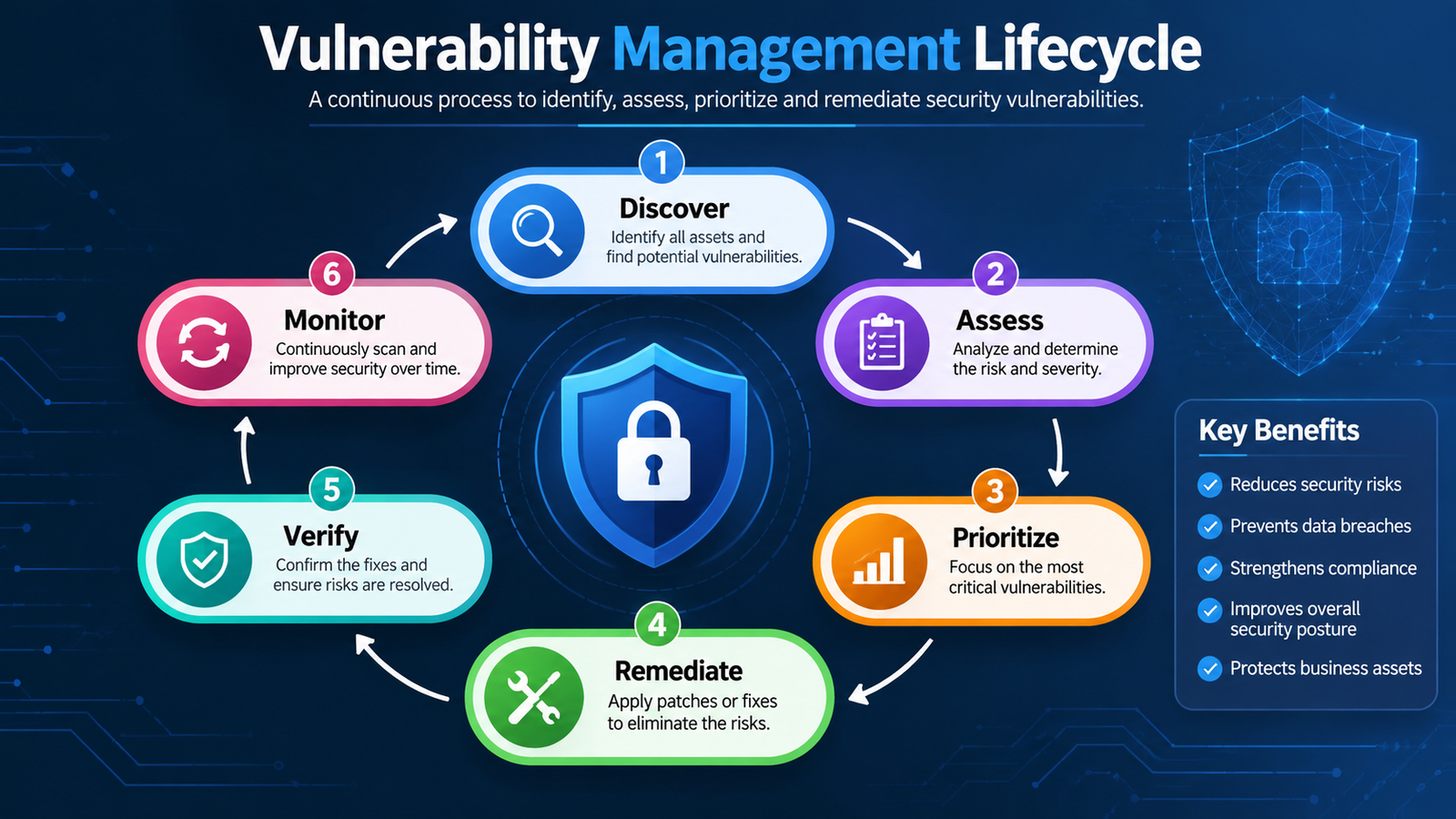
Cybersecurity teams face a constant stream of software flaws, misconfigurations, exposed systems, and newly discovered threats. Finding these weaknesses is only the beginning. The real challenge is deciding which vulnerabilities matter most, fixing them efficiently, and proving that the risk has actually been reduced.
The vulnerability management lifecycle provides a structured, continuous approach for doing exactly that. It typically involves discovering assets, identifying vulnerabilities, assessing risk, prioritizing findings, remediating or mitigating weaknesses, and verifying the results before beginning the cycle again.
There is no single universal model that requires every organization to use exactly five stages. Some frameworks divide validation, reporting, or continuous improvement into separate stages. The important principle is that vulnerability management is an ongoing risk-reduction process, not a one-time scan. NIST describes the process in terms of identifying vulnerable endpoints, evaluating exposure and impact, and prioritizing responses in the context of the organization.
What Is the Vulnerability Management Lifecycle?
The vulnerability management lifecycle is a continuous cybersecurity process used to identify weaknesses across an organization's technology environment, evaluate their risk, prioritize remediation, fix or mitigate vulnerabilities, and verify that the corrective action worked.
A practical model is Discover → Assess → Prioritize → Remediate → Verify → Report → Improve → Repeat. The cycle repeats because new vulnerabilities, assets, software versions, configurations, and attack techniques constantly appear.
For example, a company might discover 2,000 vulnerabilities during a scan. Instead of trying to patch all 2,000 immediately, its security team evaluates factors such as exploitability, asset criticality, exposure, and business impact to determine which findings require immediate action.
Why Is the Vulnerability Management Lifecycle Important?
A vulnerability scanner can produce thousands of findings, but a long vulnerability report does not automatically mean an organization has good security. Without prioritization and remediation, scanning simply creates a list of problems.
A mature vulnerability management lifecycle in cyber security turns those findings into an organized risk-reduction program. It helps security and IT teams understand what is exposed, assign ownership, establish remediation deadlines, verify fixes, and measure whether the overall risk is declining.
Modern vulnerability volumes make this approach increasingly important. NIST reported in 2026 that CVE submissions increased by 263% between 2020 and 2025 and introduced a more risk-focused approach for enriching vulnerability records.
Vulnerability Management vs. Vulnerability Assessment vs. Vulnerability Scanning
These terms are often used interchangeably, but they describe different activities.
Scanning is therefore only one component of vulnerability management. A mature program continues beyond detection into prioritization, remediation, validation, reporting, and improvement.
What Are the 5 Stages of the Vulnerability Management Lifecycle?
A commonly used five-stage model consists of:
Asset discovery and inventory
Vulnerability assessment and scanning
Risk-based prioritization
Remediation and mitigation
Verification, reporting, and continuous improvement
Some resources describe a vulnerability management lifecycle with 6 steps by separating validation or reporting into additional stages. Both approaches can be valid because organizations structure their processes differently.
What matters most is that the process covers the complete journey from identifying an asset or weakness to reducing the associated risk and confirming the outcome.
Stage 1: Asset Discovery and Inventory
You cannot effectively manage vulnerabilities on systems you do not know exist. The first stage is therefore maintaining visibility across the organization's attack surface.
This includes laptops, desktops, servers, network devices, cloud workloads, applications, APIs, containers, databases, IoT devices, and internet-facing systems. Asset discovery should also account for unmanaged or temporary resources such as shadow IT and short-lived cloud workloads.
Why Asset Inventory Matters
Consider an organization that scans 5,000 known assets but has another 500 cloud workloads that were never added to its inventory. A scan showing “high coverage” may create a misleading sense of security.
An effective inventory should identify the asset owner, business function, operating system or technology, location, exposure, and criticality wherever practical. This information becomes extremely valuable during vulnerability prioritization.
Stage 2: Vulnerability Assessment and Scanning
Once assets are identified, security teams need to discover weaknesses. Depending on the environment, this can involve network vulnerability scanners, endpoint agents, cloud security tools, web application scanners, container scanners, and configuration assessment tools.
Authenticated or credentialed scanning can provide deeper visibility than unauthenticated scanning because the assessment can inspect installed software, versions, configurations, and local security settings.
However, a scan result should not automatically be treated as confirmed risk. Findings may contain false positives, duplicates, outdated information, or vulnerabilities that are not exploitable in the organization's specific environment.
This stage should therefore answer two questions: What vulnerabilities exist, and where do they actually matter?
Stage 3: Risk-Based Vulnerability Prioritization
Prioritization is where vulnerability management becomes significantly more valuable than simply running vulnerability scans.
A vulnerability's CVSS score is useful, but it should not always be the only factor determining remediation order. NIST describes vulnerability management in terms of exposure and impact within the organization's context, while CISA recommends using its Known Exploited Vulnerabilities catalog as an input to vulnerability prioritization.
CVSS, EPSS, and CISA KEV
Security teams can combine several signals:
For example, a vulnerability with a CVSS score of 10 on an isolated test server may deserve less immediate attention than a lower-scoring vulnerability that is actively exploited and affects an internet-facing payment system.
CISA explicitly describes its KEV catalog as an authoritative source for vulnerabilities exploited in the wild and recommends using it as an input to vulnerability prioritization.
Stage 4: Vulnerability Remediation and Mitigation
After prioritization, the organization needs to reduce the risk. The preferred solution is often installing a vendor-provided security update, but remediation does not always mean patching.
Other actions can include upgrading software, changing configurations, disabling vulnerable functionality, restricting access, segmenting a network, removing unsupported software, or applying compensating controls.
What If You Cannot Patch a Vulnerability?
Legacy systems and critical production applications may not be easy to patch immediately. In those cases, teams can apply temporary mitigations while working toward a permanent solution.
A practical workflow is:
Can it be patched? → Test the update → Deploy → Verify
If it cannot:
Mitigate → Apply compensating controls → Monitor → Set an exception/review date
Risk acceptance should also be documented and periodically reviewed rather than becoming a permanent excuse for leaving a vulnerability unresolved.
Vulnerability Remediation SLAs
Organizations should establish remediation targets based on risk. There is no universal SLA that applies to every business, but an example internal policy could look like this:
These are example targets, not universal regulatory requirements. Actual deadlines should consider exploitation, asset exposure, business criticality, regulatory obligations, technical feasibility, and compensating controls.
NIST guidance has historically emphasized defining response times and prioritizing remediation according to threat and organizational impact.
Stage 5: Verification, Reporting, and Continuous Improvement
A vulnerability should not automatically be considered resolved simply because someone installed a patch. The security team should verify that the vulnerable condition is actually gone.
A typical process is:
Patch → Rescan → Validate → Close Finding → Document Evidence
If the vulnerability remains, the ticket should be reopened or reassigned for further remediation.
Reporting then helps security leaders understand trends such as critical vulnerabilities remaining open, remediation speed, asset coverage, SLA compliance, and recurring weaknesses.
The lifecycle finally returns to discovery because the environment is constantly changing.
Vulnerability Management Metrics and KPIs
Good vulnerability management programs measure risk reduction rather than simply counting scans.
Useful metrics include:
Mean time to remediate (MTTR)
Mean time to detect
Critical vulnerabilities overdue
Percentage of assets covered by scanning
Remediation SLA compliance
Vulnerability aging
Reopened findings
False-positive rate
Known exploited vulnerability remediation rate
Percentage of critical assets with current assessments
For example, reducing 5,000 findings to 4,000 is not necessarily meaningful if the remaining 4,000 include the organization's most dangerous vulnerabilities. A better KPI may be the number of critical, actively exploited vulnerabilities remaining on exposed systems.
Vulnerability Management Roles and Responsibilities
Vulnerability management works best when responsibility is shared across teams.
The security team usually manages discovery, assessment, prioritization, and reporting. IT operations may handle operating system and infrastructure patches, while DevOps addresses application and container vulnerabilities.
System owners provide business context, network teams may implement segmentation or access controls, compliance teams collect evidence, and senior security leadership oversees risk decisions.
Clear ownership prevents vulnerability tickets from remaining unresolved simply because nobody knows who is responsible.
Vulnerability Management Lifecycle Example
Imagine an e-commerce company discovers 4,800 vulnerability findings across 2,500 assets.
The security team first removes duplicate and invalid findings. It then identifies 120 internet-facing systems and discovers that several vulnerabilities are associated with known exploitation.
Instead of assigning every finding the same priority, the team focuses on actively exploited vulnerabilities affecting critical public-facing systems. IT tests patches, deploys them during approved maintenance windows, and security performs rescans afterward.
The final report records which vulnerabilities were fixed, which were mitigated, which remain open, and why. The organization then repeats the process as new assets and vulnerabilities appear.
This is the practical purpose of the vulnerability management lifecycle example: converting a large volume of technical findings into prioritized, measurable risk reduction.
Vulnerability Management Lifecycle for Cloud Environments
Cloud infrastructure makes continuous asset discovery especially important. Virtual machines, containers, serverless resources, APIs, and Kubernetes workloads can appear and disappear quickly.
A monthly scan may miss a workload that existed for only a few days. Cloud vulnerability management should therefore integrate asset discovery, configuration assessment, workload scanning, identity controls, and CI/CD processes where appropriate.
The goal is to bring vulnerability management closer to the point where infrastructure and software are created rather than waiting until weaknesses reach production.
Vulnerability Management Best Practices
A strong program should:
Maintain an accurate asset inventory.
Identify critical and internet-facing assets.
Use appropriate authenticated scanning.
Prioritize risk rather than CVSS alone.
Monitor CISA KEV and relevant threat intelligence.
Assign clear remediation ownership.
Establish risk-based SLAs.
Track exceptions and expiration dates.
Verify remediation through rescanning or other evidence.
Measure vulnerability aging and remediation performance.
Automate repetitive workflows where practical.
Review the program regularly.
The central principle is simple: focus limited security resources on the vulnerabilities that create the greatest real-world risk.
Common Vulnerability Management Mistakes
Several mistakes can weaken an otherwise sophisticated program:
Treating CVSS as the Only Priority
Severity matters, but exploitation, exposure, asset criticality, and business impact can change the actual risk.
Scanning Without Complete Asset Visibility
A perfect scan of an incomplete inventory still produces incomplete security coverage.
Closing Tickets Without Verification
A failed patch or incorrect configuration can leave the original vulnerability exposed.
Allowing Permanent Exceptions
Risk acceptance should have an owner, justification, compensating controls where appropriate, and a review date.
Measuring Activity Instead of Risk
The number of scans performed is less meaningful than whether critical exposures are being reduced.
Vulnerability Management Lifecycle Checklist
Use this simple checklist to assess your program:
Maintain a current asset inventory
Identify critical assets
Perform appropriate vulnerability assessments
Validate important findings
Establish risk-based prioritization
Monitor known exploited vulnerabilities
Assign remediation owners
Define remediation SLAs
Document exceptions
Verify remediation
Track KPIs
Report trends to leadership
Continuously improve the process
Conclusion
The vulnerability management lifecycle is ultimately a continuous risk-management process. Finding vulnerabilities is important, but discovering assets, prioritizing meaningful risk, assigning remediation, verifying fixes, and measuring results are what turn vulnerability data into stronger security.
A practical lifecycle is Discover → Assess → Prioritize → Remediate → Verify → Report → Improve → Repeat. By combining asset visibility with risk-based prioritization, remediation discipline, and continuous verification, organizations can focus their resources where they matter most.
For modern security teams, the objective is not simply to reduce the number of vulnerabilities on a dashboard. It is to continuously reduce the vulnerabilities that pose the greatest risk to the organization.
Frequently Asked Questions
What are the 5 stages of the vulnerability management lifecycle?
The five-stage model commonly consists of asset discovery, vulnerability assessment, risk-based prioritization, remediation or mitigation, and verification with reporting and continuous improvement.
What is the vulnerability management lifecycle in cybersecurity?
It is a continuous process for discovering assets and vulnerabilities, evaluating risk, prioritizing weaknesses, remediating or mitigating them, verifying the results, and improving the security program.
What is the difference between vulnerability scanning and vulnerability management?
Vulnerability scanning focuses primarily on finding potential weaknesses. Vulnerability management covers the broader process of discovery, assessment, prioritization, remediation, verification, reporting, and continuous improvement.
How do you prioritize vulnerabilities?
Use multiple risk signals, including CVSS, exploitation status, CISA KEV, EPSS, internet exposure, asset criticality, and potential business impact. CISA specifically recommends using its KEV catalog as an input to vulnerability prioritization.
Is the vulnerability management lifecycle always six steps?
No. Different organizations and vendors divide activities differently. Some use five stages, while others separate validation, reporting, or continuous monitoring into additional stages.
How often should vulnerability scanning be performed?
There is no single frequency suitable for every environment. Organizations should consider asset changes, risk, exposure, regulatory requirements, and operational needs. Critical or rapidly changing environments generally require more frequent visibility.
Why is verification important in vulnerability management?
Verification confirms that remediation actually removed or reduced the vulnerability. Without verification, a ticket can be marked complete even though the underlying security weakness remains.
Leave a Reply