

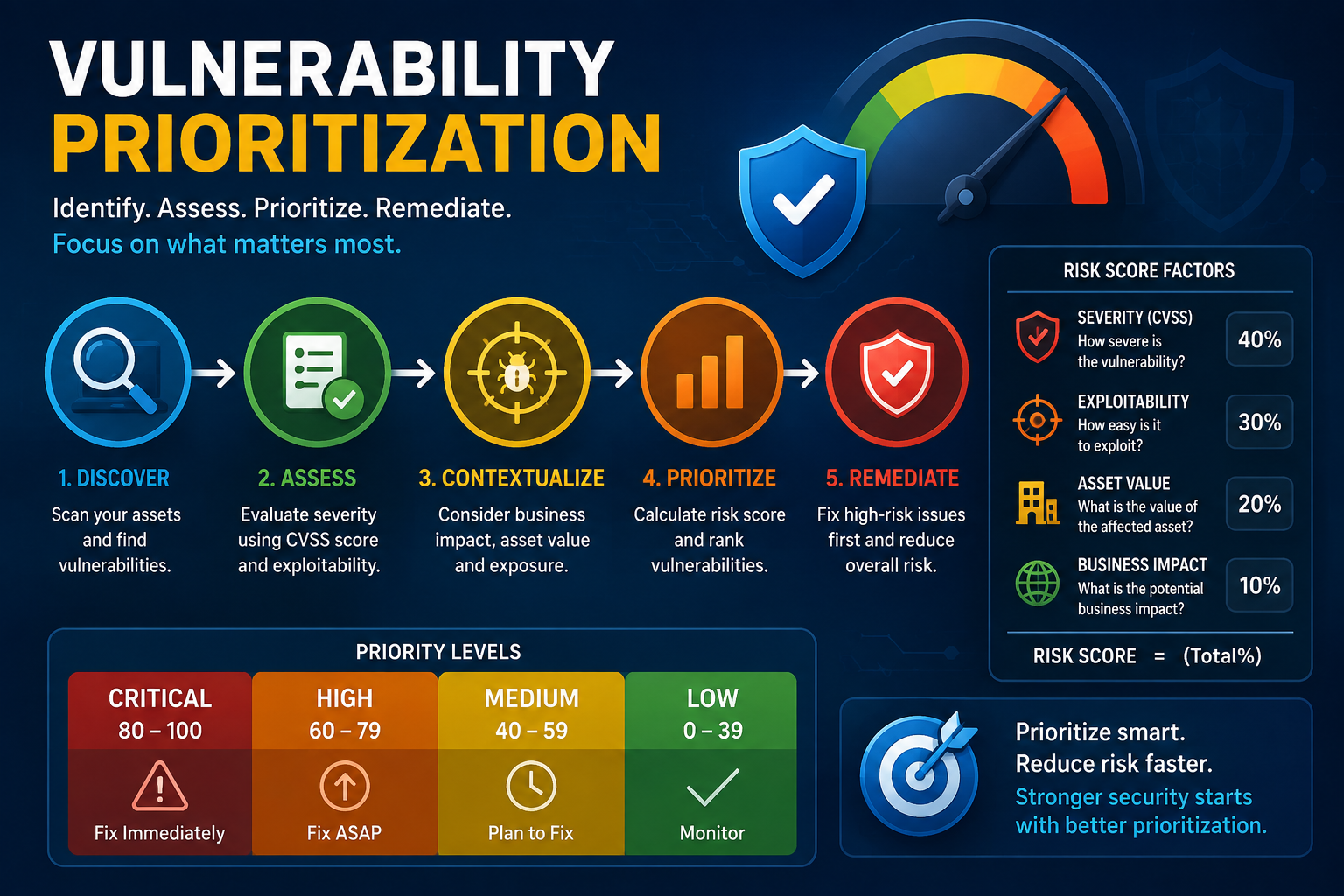
Modern organizations face a growing number of security vulnerabilities across applications, networks, cloud platforms, and endpoints. Every day, security teams discover hundreds or even thousands of weaknesses that could potentially be exploited by attackers.
However, fixing every vulnerability immediately is not practical. Security teams have limited resources, and not every vulnerability represents the same level of danger. This is where vulnerability prioritization becomes essential.
Vulnerability prioritization helps organizations identify which security weaknesses create the highest risk and should be fixed first. Instead of relying only on severity scores, modern security teams evaluate factors such as exploitability, asset importance, business impact, and threat intelligence.
A strong prioritization process allows organizations to reduce cyber risk, improve vulnerability management efficiency, and focus remediation efforts where they provide the most security value.
What Is Vulnerability Prioritization?
Vulnerability prioritization is the process of ranking security vulnerabilities according to their actual risk level and determining which issues require immediate remediation.
Traditional vulnerability management often focused only on severity ratings, such as CVSS (Common Vulnerability Scoring System). While CVSS is useful for measuring technical impact, it does not always represent the real-world risk faced by an organization.
For example, a medium-severity vulnerability affecting an internet-facing banking application may be more dangerous than a critical vulnerability located on an isolated internal testing server.
A modern vulnerability prioritization approach combines multiple security factors, including:
Vulnerability severity
Exploit availability
Asset criticality
Business impact
Exposure level
Threat intelligence
Compliance requirements
The main goal is to help security teams identify the vulnerabilities most likely to cause damage and address them before attackers can take advantage.
Why Is Vulnerability Prioritization Important?
Organizations today struggle with vulnerability overload. Security scanners can generate thousands of findings, making it difficult for teams to determine which issues deserve immediate attention.
Without a proper prioritization strategy, teams may spend valuable time fixing low-risk vulnerabilities while leaving high-impact security weaknesses exposed.
Reduces Security Risk
A strong vulnerability prioritization cybersecurity strategy allows organizations to focus on vulnerabilities that represent the greatest threat.
Instead of treating every vulnerability equally, security teams analyze real-world conditions such as whether attackers are actively exploiting a weakness or whether the affected system contains sensitive information.
This approach reduces the likelihood of successful cyberattacks and improves overall security posture.
Improves Security Team Efficiency
Security teams often have limited time and resources. Prioritization helps them create a structured remediation plan instead of randomly addressing vulnerabilities.
For example, a company may have 15,000 vulnerabilities across its environment. A prioritization process can identify the top 100 vulnerabilities that create the highest risk and require immediate action.
This allows teams to work smarter and achieve greater risk reduction with fewer resources.
Supports Compliance and Security Requirements
Many industries require organizations to maintain effective vulnerability management processes. A documented prioritization method helps demonstrate that security risks are being actively identified, evaluated, and addressed.
Organizations can use prioritization reports to show security improvements during audits and compliance reviews.
How Does Vulnerability Prioritization Work?
An effective vulnerability prioritization process involves several stages. Security teams collect vulnerability information, analyze risk factors, assign priorities, and track remediation progress.
Identify and Discover Vulnerabilities
The first step is discovering vulnerabilities across the organization's digital environment.
Common discovery methods include:
Vulnerability scanners
Penetration testing
Security assessments
Cloud security monitoring
Application security testing
Examples of vulnerabilities include:
Outdated software versions
Missing security patches
Misconfigured cloud resources
Weak authentication mechanisms
Exposed network services
Discovery creates a complete vulnerability inventory, but finding vulnerabilities alone does not determine which ones should be fixed first.
Analyze Vulnerability Severity Using CVSS
The CVSS framework is one of the most commonly used methods for evaluating vulnerability severity.
CVSS provides a numerical score based on factors such as:
Attack complexity
Required privileges
User interaction
Confidentiality impact
Integrity impact
Availability impact
A higher CVSS score usually indicates a more severe vulnerability.
Although CVSS is valuable, it should not be the only factor used for prioritization because it does not always include business context.
Evaluate Asset Importance and Business Impact
A vulnerability's risk depends heavily on where it exists.
Security teams consider questions such as:
Does the vulnerability affect a critical business system?
Is sensitive customer data stored on the affected asset?
Is the system accessible from the internet?
How many users depend on this application?
For example, a vulnerability affecting a company's customer database should receive higher priority than the same vulnerability affecting a temporary development environment.
This business-focused approach is the foundation of risk-based prioritization.
Analyze Exploitability and Threat Intelligence
Not every vulnerability is actively targeted by attackers. Security teams need to understand whether a vulnerability is likely to be exploited.
Important exploitability indicators include:
Publicly available exploit code
Active attacks in the wild
Threat intelligence reports
Proof-of-concept availability
Malware campaigns targeting the vulnerability
Organizations often use resources such as the CISA Known Exploited Vulnerabilities (KEV) catalog to identify vulnerabilities that attackers are already using.
Vulnerability Prioritization Frameworks and Models
A vulnerability prioritization framework provides a structured method for evaluating vulnerabilities and deciding remediation priorities.
Different organizations use different frameworks depending on their security needs, industry requirements, and risk tolerance.
CVSS-Based Prioritization
CVSS is a standardized scoring system used worldwide to measure vulnerability severity.
It helps security teams quickly categorize vulnerabilities and compare risks across different systems.
Advantages of CVSS include:
Widely adopted standard
Easy vulnerability comparison
Supported by security tools
Useful for initial risk assessment
However, CVSS has limitations because it does not fully consider:
Business importance
Asset exposure
Active exploitation
Organization-specific risks
For this reason, many organizations combine CVSS with additional risk factors.
EPSS (Exploit Prediction Scoring System)
EPSS helps predict the likelihood that a vulnerability will be exploited in the near future.
Unlike CVSS, which measures technical severity, EPSS focuses on exploitation probability.
Security teams use EPSS data to identify vulnerabilities that attackers are more likely to target.
For example, two vulnerabilities may have similar CVSS scores, but the one with a higher EPSS score may require faster remediation because it has a greater chance of exploitation.
Risk-Based Vulnerability Management
Risk-based vulnerability management moves beyond traditional vulnerability scanning by focusing on actual business risk.
This approach combines:
Vulnerability severity
Threat intelligence
Asset value
Exposure information
Business impact
Risk-based vulnerability management helps organizations avoid spending excessive time on vulnerabilities that create little practical danger.
Example:
A critical vulnerability on an unused internal server may receive a lower priority than a high-severity vulnerability affecting an exposed customer-facing application.
SSVC Framework
Stakeholder-Specific Vulnerability Categorization (SSVC) is a decision-based framework that helps organizations determine what action should be taken after discovering a vulnerability.
Instead of only assigning a score, SSVC helps answer questions such as:
Should this vulnerability be fixed immediately?
Can remediation wait?
Should additional monitoring be performed?
This makes vulnerability decisions more consistent and aligned with business needs.
Vulnerability Prioritization Matrix Explained
A vulnerability prioritization matrix is a structured method that helps security teams categorize vulnerabilities based on different risk factors. It allows organizations to quickly identify which vulnerabilities need immediate attention and which ones can be handled later.
A prioritization matrix usually combines factors such as vulnerability severity, exploit availability, asset importance, and business impact.
For example, a critical vulnerability affecting an internet-facing customer database will receive a much higher priority than a similar vulnerability affecting a low-value internal system.
A vulnerability prioritization matrix creates consistency across security teams and prevents decisions from being based only on assumptions or severity scores.
Vulnerability Prioritization Example
Understanding a practical vulnerability prioritization example makes it easier to see why risk-based decisions matter.
Imagine a company discovers two vulnerabilities:
Vulnerability A
CVSS Score: 9.8 (Critical)
Located on an internal testing server
No known exploit available
Does not contain sensitive information
Vulnerability B
CVSS Score: 7.5 (High)
Located on a public customer portal
Active exploitation reported
Handles customer account data
Although Vulnerability A has a higher CVSS score, Vulnerability B represents a greater business risk.
A risk-based vulnerability management approach would prioritize Vulnerability B because attackers have a higher chance of exploiting it and the potential impact is much greater.
This example shows why organizations should evaluate context instead of depending only on vulnerability severity.
Vulnerability Prioritization vs Vulnerability Severity
Many organizations confuse vulnerability severity with vulnerability prioritization. Although both concepts are related, they serve different purposes.
Severity explains how damaging a vulnerability could be under certain conditions, while prioritization determines how quickly an organization should respond.
For example, a critical vulnerability may not always be the first issue to fix if it affects a non-critical system. Meanwhile, a high-risk vulnerability affecting essential business operations may require immediate attention.
Common Vulnerability Prioritization Mistakes
Even organizations with mature security programs can make mistakes when prioritizing vulnerabilities. Avoiding these common problems improves risk management effectiveness.
Relying Only on CVSS Scores
One of the biggest mistakes is using CVSS as the only prioritization method.
CVSS provides valuable technical information, but it does not consider:
Business importance
Data sensitivity
Current attack activity
System exposure
Security teams should combine CVSS with additional intelligence for better decisions.
Treating All Vulnerabilities Equally
A large vulnerability backlog can overwhelm security teams if every issue is treated with the same urgency.
Organizations should focus first on vulnerabilities that:
Affect critical assets
Have active exploits
Create significant business risk
This reduces wasted effort and improves remediation speed.
Ignoring Asset Context
A vulnerability's importance depends on where it exists.
A vulnerability affecting:
A public web application
A financial database
A healthcare system
is usually more serious than the same vulnerability affecting an isolated internal device.
Failing to Track Active Threats
Attack techniques change constantly. A vulnerability that was considered low priority yesterday may become dangerous after attackers release exploit tools.
Security teams should continuously monitor:
Threat intelligence feeds
Exploit databases
Security advisories
Active attack campaigns
Best Practices for Effective Vulnerability Prioritization
A successful vulnerability prioritization program requires more than vulnerability scanning. Organizations need a consistent process that combines technology, security expertise, and business understanding.
Maintain an Accurate Asset Inventory
Security teams cannot prioritize vulnerabilities correctly without knowing what assets exist.
Organizations should maintain visibility into:
Servers
Applications
Cloud resources
Endpoints
Databases
Network devices
An accurate asset inventory helps determine which vulnerabilities affect the most important systems.
Combine Multiple Risk Factors
Effective prioritization considers multiple signals instead of relying on a single score.
Important factors include:
CVSS rating
Exploit probability
Business impact
Asset criticality
Exposure level
Compliance requirements
Combining these factors creates a more accurate risk picture.
Automate Vulnerability Analysis
Automation helps security teams process large amounts of vulnerability data quickly.
Modern security platforms can automatically:
Identify high-risk vulnerabilities
Connect vulnerabilities with assets
Analyze attack paths
Recommend remediation actions
Automation reduces manual effort and allows teams to focus on strategic security improvements.
Create Clear Remediation Policies
Organizations should define clear timelines for fixing different risk levels.
Example:
Clear policies improve accountability and ensure important vulnerabilities are not ignored.
Metrics to Measure Vulnerability Prioritization Success
Security teams need measurable goals to understand whether their prioritization process is effective.
Important vulnerability management metrics include:
Mean Time To Remediate (MTTR)
MTTR measures how quickly an organization fixes vulnerabilities after discovery.
A lower MTTR usually indicates a more efficient remediation process.
Critical Vulnerability Backlog
Tracking unresolved critical vulnerabilities helps organizations understand their current risk exposure.
Reducing the backlog over time shows improvement in security operations.
SLA Compliance Rate
This metric measures whether teams are fixing vulnerabilities within the expected timeframe.
High SLA compliance indicates strong vulnerability management discipline.
Risk Reduction Score
Risk reduction measures whether remediation activities are actually lowering security exposure.
The goal is not simply reducing vulnerability numbers but reducing meaningful business risks.
How AI Improves Vulnerability Prioritization
Artificial intelligence is transforming how organizations analyze and prioritize security vulnerabilities.
AI-powered security solutions can evaluate large amounts of security data and identify patterns that humans may miss.
AI can help with:
Predicting exploitation likelihood
Identifying attack paths
Correlating threat intelligence
Automatically ranking vulnerabilities
Reducing false positives
For example, an AI system may identify that a medium-severity vulnerability is dangerous because it exists on an exposed system connected to sensitive business applications.
However, AI should support security professionals rather than replace human decision-making. Business context and expert judgment remain essential.
Vulnerability Prioritization Checklist
Organizations can use the following checklist to improve their vulnerability prioritization process:
✅ Maintain complete asset visibility
✅ Identify critical business systems
✅ Review CVSS scores
✅ Analyze exploit availability
✅ Monitor threat intelligence
✅ Apply a vulnerability prioritization framework
✅ Consider business impact
✅ Assign remediation owners
✅ Track remediation progress
✅ Validate security fixes
A consistent checklist helps organizations create a repeatable and reliable security process.
Conclusion
Vulnerability prioritization is a fundamental part of modern cybersecurity because organizations cannot fix every vulnerability at the same time.
By combining CVSS scores, threat intelligence, asset importance, exploitability, and business impact, security teams can focus on vulnerabilities that create the greatest risk.
A strong risk-based vulnerability management strategy helps organizations reduce attack exposure, improve remediation efficiency, and build a stronger security foundation.
Instead of chasing every vulnerability equally, organizations should prioritize the weaknesses that matter most.
FAQs About Vulnerability Prioritization
What is vulnerability prioritization?
Vulnerability prioritization is the process of ranking security vulnerabilities based on risk factors such as severity, exploitability, asset importance, and business impact to determine which issues should be fixed first.
Why is vulnerability prioritization important in cybersecurity?
Vulnerability prioritization cybersecurity practices help organizations focus resources on the most dangerous vulnerabilities instead of wasting time on low-impact issues.
Is CVSS enough for vulnerability prioritization?
No. CVSS is useful for measuring vulnerability severity, but it does not consider business context, asset value, or active exploitation. Organizations should combine CVSS with other risk factors.
What factors affect vulnerability prioritization?
Key factors include vulnerability severity, exploit availability, asset criticality, system exposure, threat intelligence, compliance requirements, and business impact.
What is a vulnerability prioritization matrix?
A vulnerability prioritization matrix is a tool that helps security teams rank vulnerabilities by combining severity, asset importance, and exploitation risk.
How does risk-based vulnerability management improve security?
Risk-based vulnerability management focuses on real-world business risk instead of vulnerability volume, helping organizations fix the vulnerabilities most likely to cause damage.
What is the role of AI in vulnerability prioritization?
AI helps security teams analyze large amounts of vulnerability data, predict threats, identify attack paths, and improve remediation decisions.
Leave a Reply