

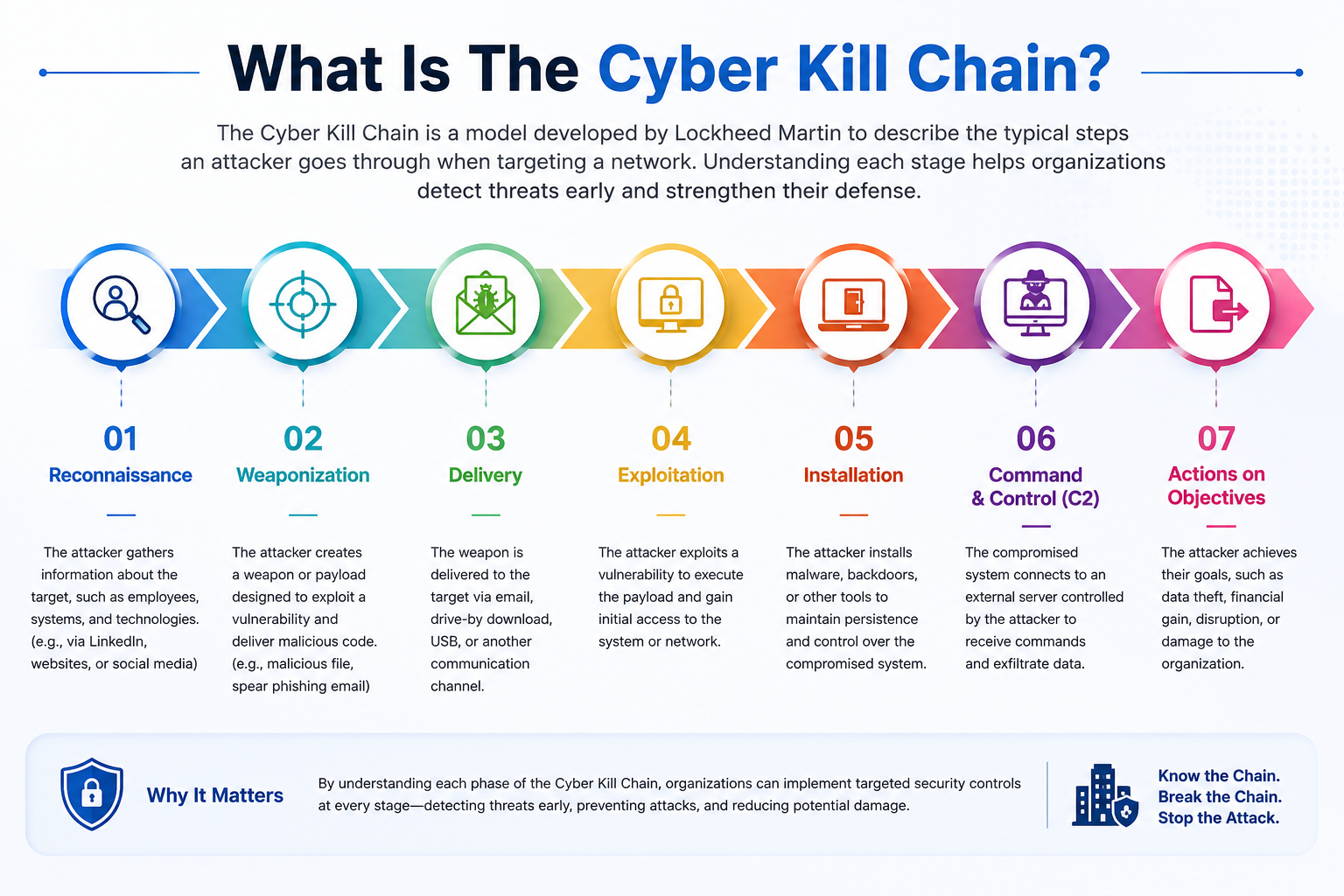
Cyberattacks are not random events. Most sophisticated attacks follow a planned sequence where attackers research targets, prepare malicious tools, gain access, maintain control, and eventually achieve their objectives. Understanding this process allows security teams to detect threats earlier and prevent serious damage.
The Cyber Kill Chain is a cybersecurity framework that explains the different stages attackers follow when conducting targeted attacks. Developed by Lockheed Martin, this framework helps organisations understand attacker behaviour, improve threat detection, and create stronger defence strategies.
In this guide, we will explain what is the cyber kill chain in cyber security, explore the seven Cyber Kill Chain stages with examples, compare it with modern frameworks like MITRE ATT&CK, and explain why it remains important for cybersecurity professionals.
What Is the Cyber Kill Chain?
The Cyber Kill Chain is a cybersecurity framework that describes the step-by-step process attackers use to execute cyberattacks. It breaks down an attack into different stages, allowing security teams to identify and stop threats before attackers reach their final objective.
The framework follows the idea that attackers must complete several steps before successfully compromising an organisation. By detecting activity during earlier stages, defenders can interrupt attacks before they cause major harm.
The Cyber Kill Chain is commonly used in threat intelligence, security operations centres (SOCs), incident response, and cybersecurity education.
For example, if a company detects a phishing attempt during the delivery stage, it can block the malicious email before malware reaches an employee.
What Is the Cyber Kill Chain Lockheed Martin Developed?
The Lockheed Martin Cyber Kill Chain was introduced in 2011 to help organisations understand advanced persistent threats (APTs). Lockheed Martin created the framework after analysing how sophisticated attackers plan and execute targeted cyber operations.
The main purpose of the framework was to help defenders move from reactive security practices to proactive threat prevention.
Instead of waiting until an attack succeeds, organisations can monitor each stage of the attack lifecycle and apply security controls to disrupt attackers.
The framework is commonly used for analysing:
Advanced persistent threats
Malware campaigns
Ransomware attacks
Targeted phishing attacks
Data theft operations
Cyber espionage activities
How Does the Cyber Kill Chain Work?
The Cyber Kill Chain explains how attackers move from initial planning to achieving their final objective.
The seven stages are:
Reconnaissance
Weaponization
Delivery
Exploitation
Installation
Command and Control
Actions on Objectives
Each stage provides security teams with an opportunity to detect malicious activity and prevent further progression.
The 7 Cyber Kill Chain Stages With Examples
1. Reconnaissance
Reconnaissance is the first stage where attackers collect information about their target.
Attackers may gather information about:
Employees
Email addresses
Company infrastructure
Public websites
Software systems
Security weaknesses
Reconnaissance Cyber Kill Chain Example
An attacker may search LinkedIn profiles to identify employees in the finance department and collect information that can be used for a targeted phishing campaign.
Defence Strategies
Organisations can reduce reconnaissance risks by:
Monitoring exposed assets
Using threat intelligence
Limiting unnecessary public information
Performing security assessments
2. Weaponization
Weaponization involves preparing malicious tools that will be used during the attack.
Attackers may create:
Malware
Exploit files
Malicious documents
Remote access tools
For example, an attacker may create a document containing malicious code that exploits a vulnerability when opened by a victim.
Defence Strategies
Security teams can defend against weaponization through:
Malware analysis
Email security solutions
File sandboxing
Endpoint protection
3. Delivery
The delivery stage involves sending the malicious payload to the target.
Common delivery methods include:
Phishing emails
Malicious links
Infected websites
USB devices
Cyber Kill Chain Example
A cybercriminal sends an email pretending to be a trusted supplier. The email contains an attachment that installs malware when opened.
Defence Strategies
Companies can reduce delivery risks by using:
Email filtering
Employee security training
Web protection tools
Multi-factor authentication
4. Exploitation
During exploitation, attackers use vulnerabilities to gain access to systems.
Common exploitation methods include:
Unpatched software
Weak passwords
Zero-day vulnerabilities
Browser exploits
Example
An attacker exploits outdated software on a company server to gain unauthorised access.
Defence Strategies
Organisations should focus on:
Regular patching
Vulnerability management
Strong authentication
Security monitoring
5. Installation
The installation stage allows attackers to establish a permanent presence inside a compromised system.
Attackers may install:
Malware
Backdoors
Remote access software
Additional attack tools
Their goal is to maintain access even after the initial compromise.
Defence Strategies
Security teams use:
Endpoint Detection and Response (EDR)
Application controls
Behaviour monitoring
Privileged access management
6. Command and Control (C2)
Command and Control is the stage where attackers communicate with compromised devices.
Attackers use C2 channels to:
Send commands
Steal information
Move across networks
Deploy additional malware
Defence Strategies
Organisations can detect command and control activity using:
Network monitoring
Intrusion detection systems
DNS filtering
Traffic analysis
7. Actions on Objectives
This is the final stage where attackers achieve their main goal.
Attackers may:
Steal confidential data
Deploy ransomware
Conduct financial fraud
Damage systems
Perform espionage
Cyber Kill Chain Example
In a ransomware attack, attackers encrypt company files and demand payment after gaining control of critical systems.
Defence Strategies
Businesses should implement:
Data protection solutions
Backup systems
Incident response plans
Continuous monitoring
Cyber Kill Chain Stages With Examples
Real-World Cyber Kill Chain Examples
A ransomware attack is one of the most common examples of the Cyber Kill Chain.
The attack may happen like this:
An attacker researches a company and identifies employees who can be targeted. The attacker creates a malicious file and sends it through email. Once the employee opens the attachment, malware installs on the device.
The attacker then establishes command and control access, moves through the network, and finally encrypts important files.
This example shows why detecting attacks early is critical. Stopping an attacker during reconnaissance, delivery, or exploitation can prevent the entire attack.
Cyber Kill Chain vs MITRE ATT&CK
The Cyber Kill Chain and MITRE ATT&CK are both cybersecurity frameworks, but they focus on different areas.
Cyber Kill Chain vs MITRE ATT&CK
The Cyber Kill Chain provides a high-level view of how attacks progress from planning to execution.
MITRE ATT&CK provides detailed information about specific attacker behaviours, techniques, and tactics.
Many cybersecurity teams use both frameworks together. The Cyber Kill Chain explains the overall attack journey, while MITRE ATT&CK helps analysts identify specific methods attackers use.
What Is Unified Kill Chain?
The Unified Kill Chain is an expanded framework designed to address some limitations of the traditional Cyber Kill Chain.
Modern attacks often involve cloud environments, identity theft, supply-chain compromises, and multiple attack paths. Unified Kill Chain includes additional phases to represent these complex attack methods.
It combines ideas from:
Cyber Kill Chain
MITRE ATT&CK
Other threat modelling frameworks
Security professionals use Unified Kill Chain to analyse advanced cyber threats more effectively.
Benefits of Using the Cyber Kill Chain Framework
Improved Threat Detection
The framework helps security teams identify attacker activity earlier and stop attacks before they progress.
Better Incident Response
Security analysts can investigate attacks systematically by understanding which stage attackers reached.
Stronger Security Planning
Organisations can map security controls to different attack phases.
Enhanced Threat Intelligence
The framework helps security teams understand attacker strategies and improve defence methods.
Limitations of the Cyber Kill Chain
Although the Cyber Kill Chain remains valuable, it has some limitations.
Modern Attacks Are More Complex
Many modern attacks do not follow a simple step-by-step process.
Limited Technical Detail
The framework explains attack stages but does not provide detailed attacker techniques like MITRE ATT&CK.
Less Focus on Insider Threats
The model mainly focuses on external attackers rather than internal security risks.
Requires Additional Frameworks
Many organisations combine it with other models for complete cybersecurity coverage.
How Organisations Use the Cyber Kill Chain Today
Security teams use the Cyber Kill Chain for:
Threat Hunting
Analysts search for indicators that attackers may be progressing through different stages.
Security Monitoring
SOC teams monitor suspicious behaviour across networks and endpoints.
Employee Training
The framework helps employees understand phishing and social engineering techniques.
Incident Investigation
Security professionals use it to reconstruct how an attack happened.
Conclusion
The Cyber Kill Chain is an important cybersecurity framework that helps organisations understand how attackers plan and execute cyberattacks. By analysing the seven stages, security teams can identify weaknesses, improve detection, and respond more effectively.
Although newer frameworks such as MITRE ATT&CK and Unified Kill Chain provide deeper technical analysis, the Cyber Kill Chain remains a valuable foundation for cybersecurity professionals and organisations looking to strengthen their defence strategies.
Frequently Asked Questions About Cyber Kill Chain
What is the Cyber Kill Chain in cyber security?
The Cyber Kill Chain is a framework that explains the stages attackers follow during a cyberattack. It helps security teams detect threats and stop attacks before attackers achieve their objectives.
Who created the Cyber Kill Chain?
The Cyber Kill Chain was created by Lockheed Martin in 2011 to help organisations understand and defend against advanced cyber threats.
What are the seven Cyber Kill Chain stages?
The seven stages are reconnaissance, weaponization, delivery, exploitation, installation, command and control, and actions on objectives.
Is the Cyber Kill Chain still relevant?
Yes, the Cyber Kill Chain is still useful for understanding attack behaviour, although many organisations combine it with frameworks like MITRE ATT&CK and Unified Kill Chain.
How is Cyber Kill Chain different from MITRE ATT&CK?
Cyber Kill Chain focuses on the overall attack process, while MITRE ATT&CK focuses on detailed attacker techniques and behaviours.
What are some Cyber Kill Chain examples?
Examples include ransomware attacks, phishing campaigns, malware infections, and advanced persistent threats.
Leave a Reply